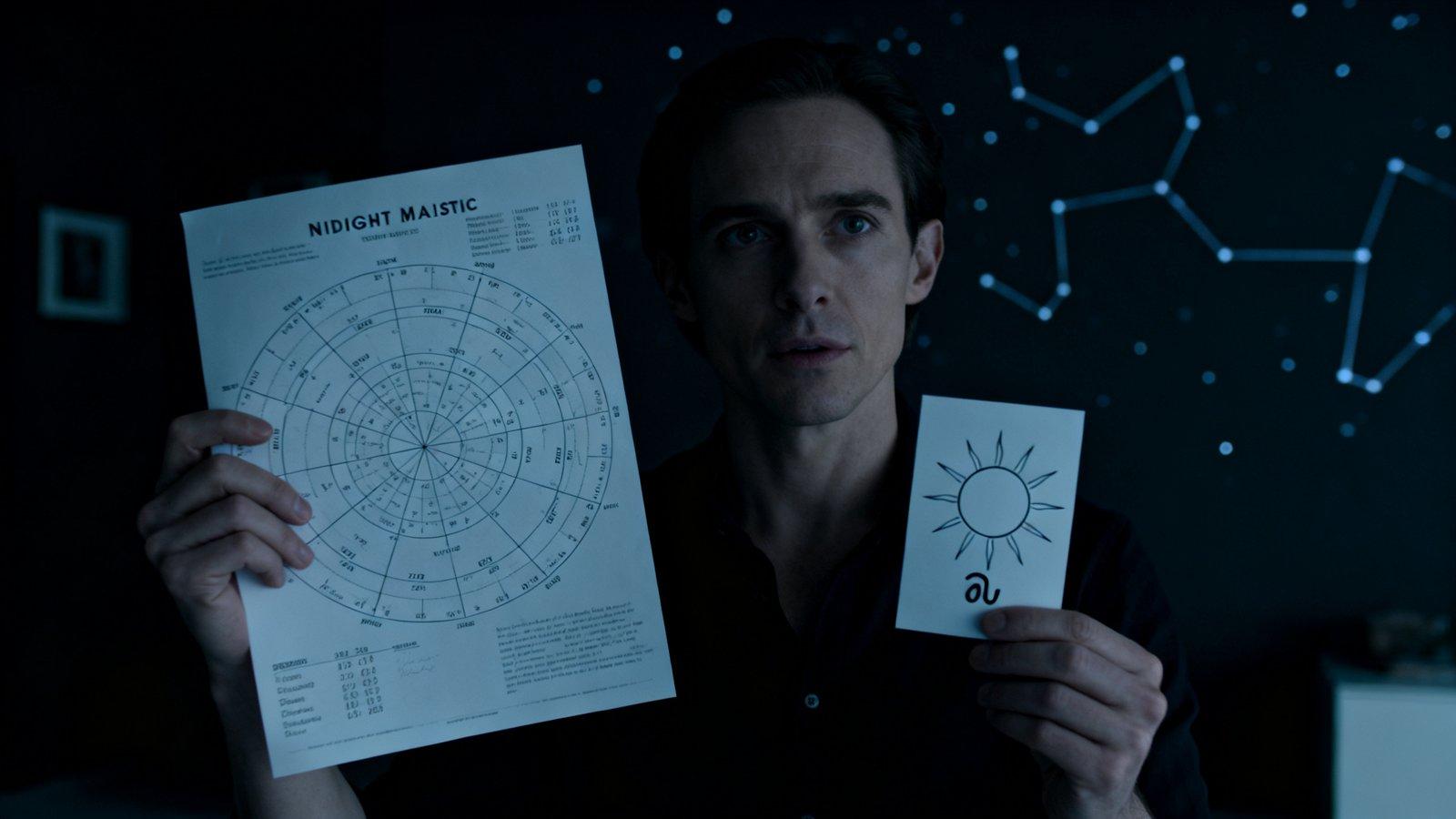
A coworker texts you a Gemini horoscope at 11:40 p.m. It is cheerful. It is also written for everyone born across a month. An astrology chart reading does not start there. It starts with a birth date, a birth time, and a birth place, then builds a natal chart from those three facts.
If those three are missing, you do not have a chart reading. You have a guess dressed as one.
A chart reading needs your data, not your sun sign
Your sun sign is one placement. It is the sign the Sun occupied on your birthday. Useful, and thin.
A natal chart (also called a birth chart) is a map of the sky at the minute you were born, calculated for the coordinates of the place. It includes the Sun, Moon, Mercury, Venus, Mars, Jupiter, Saturn, and the outer planets, plus the Ascendant, house cusps, and the major aspects between them. Two people with the same sun sign can have opposite Moons, different rising signs, and completely different house layouts.
Search “astrology chart reading” and you will see a mix of 15-minute sun-sign videos and 40-page natal reports. They are not the same product. One talks to a twelfth of the calendar. The other talks to one birth.
Birth time is doing more work than the date
The date sets the planetary signs, more or less. The time sets the rising sign and the houses.
The Ascendant moves about one sign every two hours. Guess noon because the hospital paperwork is messy, and you can put the entire house system in the wrong neighborhood of a life. Career in the 10th for one birth time can land in the 7th a few hours later. Same birthday. Different story.
If you only have a window (“sometime after dinner, before midnight”), say that. A window is honest. A fake 12:00 looks precise and still warps the houses.
Place matters too. The same minute in Manila and in Madrid is not the same local sky. A chart reading that skips city and country is skipping the coordinate that makes the houses calculable.
What belongs in the report
A serious astrology chart reading should be able to answer a short list of questions without hand-waving.
Personality is not a list of traits copied from a sign cookbook. It is the mix: Sun and Moon, rising sign, the condition of Mercury for how you think, Venus and Mars for want and conflict. If the Moon is in a night chart versus a day chart, the tone changes. If Mercury is retrograde in the natal chart, that is a fact of the map, not a personality insult.
Timing is the next layer. Transits, progressions, and (in Vedic work) dashas are different clocks. A reading that never mentions time is a character sketch. A reading that only mentions time is a weather report. You want both.
Blind spots belong in the file. Saturn, hard aspects, empty houses, and repeating patterns are not here to scare you. They flag where you keep using the same move and calling it fate.
Conditions under which you thrive should be specific. “You need balance” is filler. “You work better with a closed door and a deadline you chose” is closer to a usable line, and it still has to be traced back to placements, not invented because it sounds kind.
If a report cannot point from a sentence back to a placement, it is copywriting, not a chart reading.

What a horoscope leaves out
Daily and weekly horoscopes are entertainment with a calendar attached. They can be well written. They cannot see your 7th house, your natal Saturn, or the year your dasha changed.
They also cannot see conflict inside the chart. A Sun that wants visibility and a 12th-house Saturn that wants privacy will not fit in one sun-sign paragraph. A chart reading is supposed to hold that tension instead of picking the prettier sentence.
That is why “custom astrological report” is not a luxury label. It is the minimum if the promise is that this is about you.
One chart, more than one language
Western tropical astrology is what most English-language clients mean by a natal chart: houses, aspects, transits.
Vedic (Jyotish) work uses the sidereal zodiac and timed periods called dashas. The signs can look “different” from a Western chart of the same birth. That is the ayanamsha, not a computer error.
Bazi (Four Pillars) is not a wheel. It is a set of pillars from year, month, day, and hour, plus luck cycles. Birth gender is used for the direction of those cycles. If a “chart reading” never asks gender and then claims to do Bazi timing, something was skipped.
You do not need all three systems for every question. You do need to know which system you paid for. Mixing them without saying so is how people end up with three sun signs and no idea which one to live with.
How to sit down with a finished reading
Read it twice. First pass: ignore predictions. Mark the lines that already match how you make decisions at 2 a.m. Second pass: timing. Circle dates and periods. If a line cannot survive the first pass, the second pass is noise.
Do not treat a PDF as medical, legal, or financial advice. A chart is a map of tendencies and timing language. It is not a diagnosis and it is not a court document.
If you want a full file instead of a sun-sign paragraph, that is the job of a custom report. The Midnight Trinity Dossier is Midnight Majestic’s version of that: Western, Vedic, and Bazi on the same birth, written into one PDF and emailed within 7 days. The page for it is https://midnightmajestic.com/midnight-trinity-dossier/.