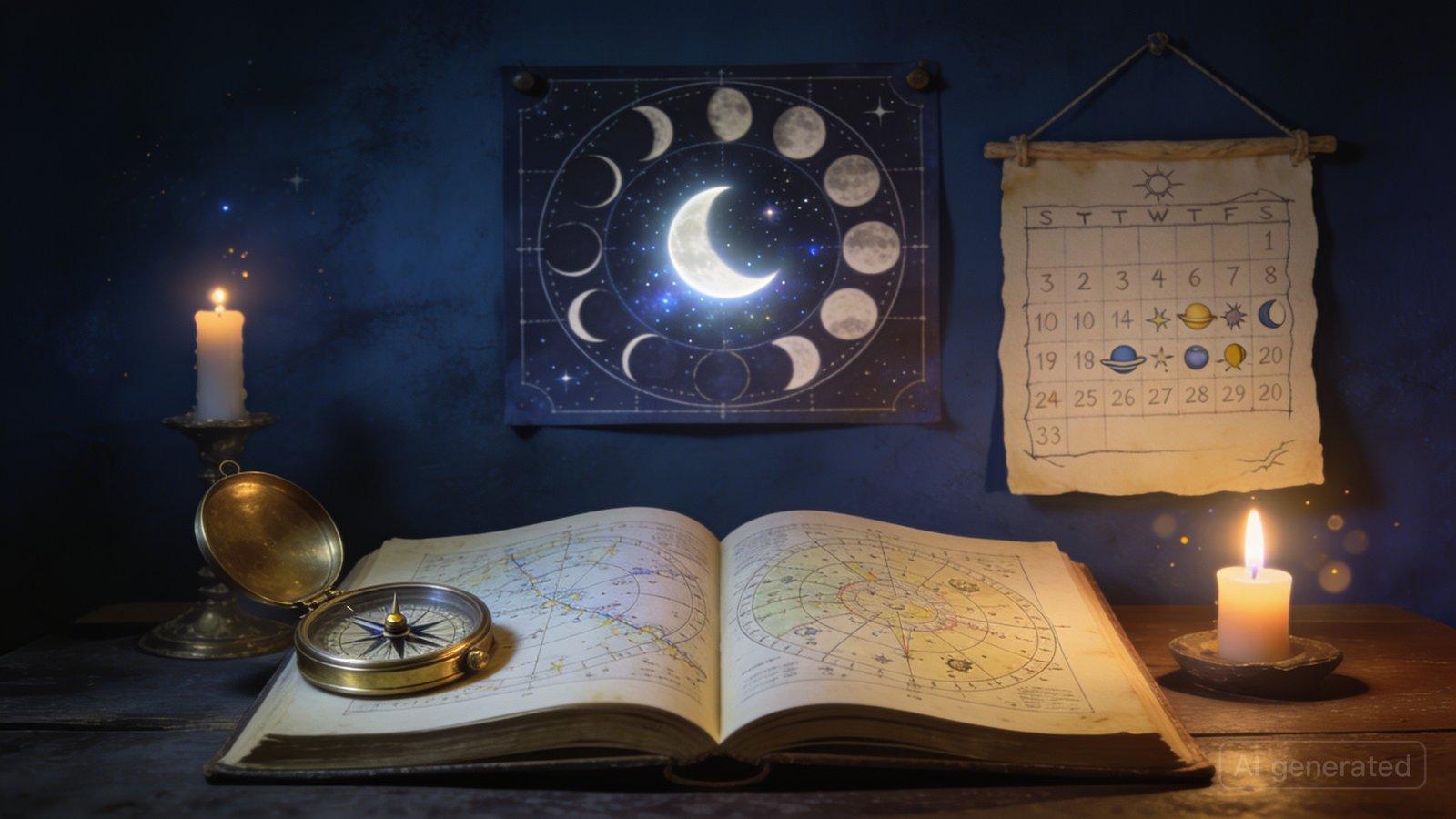
Most daily horoscopes reduce astrology to a single sign and a vague mood forecast. If you are doing Reiki, coaching, or any energy-sensitive work, that level of abstraction is not enough. An astrological energy calendar tracks the actual sky: planetary ingresses, lunar phase shifts, void-of-course Moon periods, and applying aspects. It gives you a practical scheduling layer rather than a personality label. This article outlines a method you can build in one evening and refine weekly.
Why Sun-Sign Horoscopes Fail for Energy Work
Sun-sign columns assume that everyone born under one sign experiences the same transit in the same way. But a transit to your Sun is not the same as a transit to your Moon, your ascendant, or a progressed planet. For daily alignment, you do not need a birth chart at first. You need the current sky conditions. The sky is a shared weather system. Tracking it helps you choose when to act, when to rest, and when to hold.
Sun-sign reductionism also ignores that the Moon changes sign every two and a half days, Mercury has speed cycles, and a void-of-course Moon can pause the emotional tone for hours. An astrological energy calendar is not about predicting personality. It is about mapping qualitative shifts in available energy so you can work with them instead of against them.
The Four Layers of an Astrological Energy Calendar
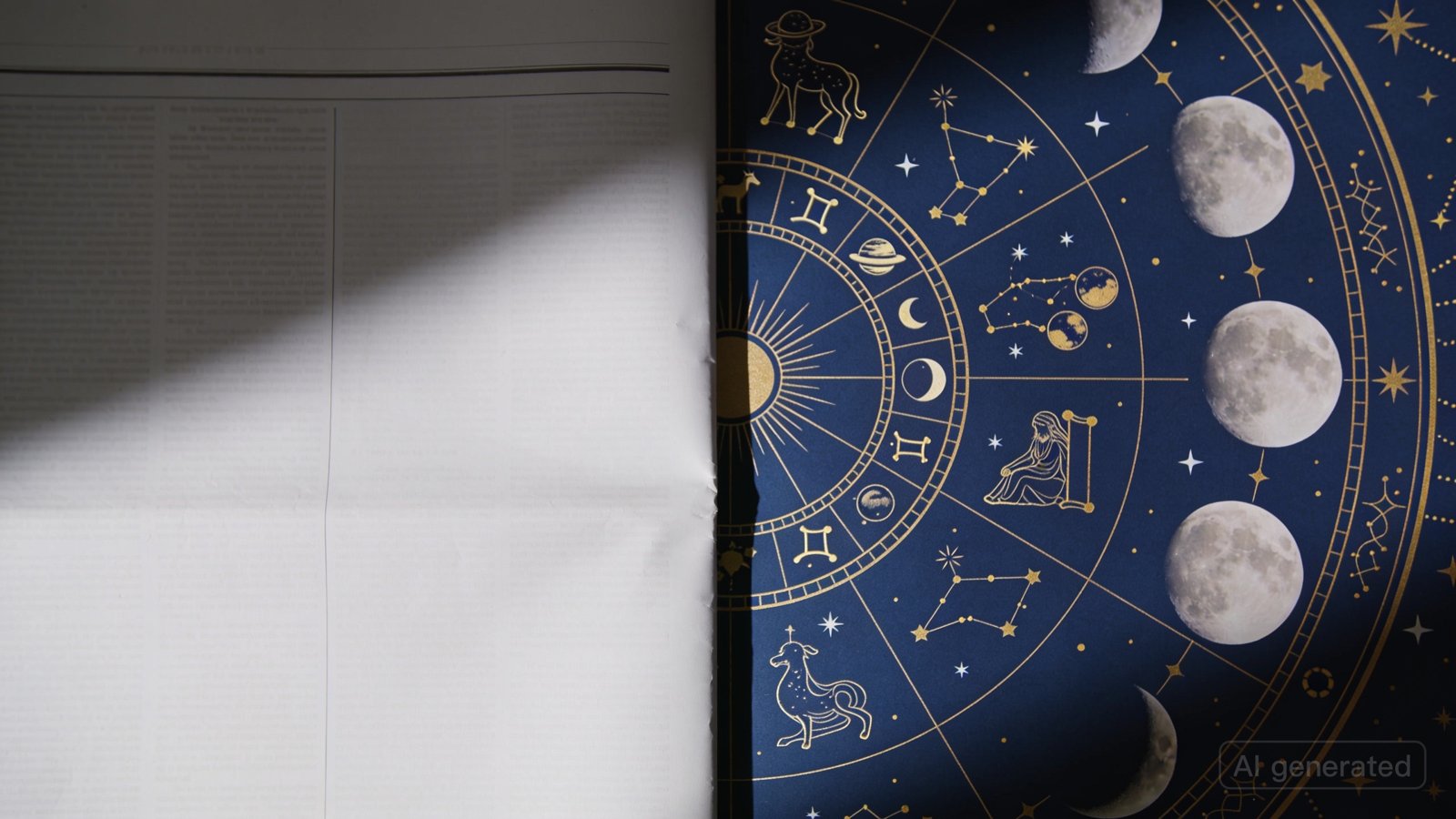
Build the calendar around four layers. Each layer answers a different question.
- Planetary ingresses: when a planet enters a new sign, shifting the tone of that planetary function.
- Lunar phases: new, first quarter, full, last quarter, and the days between them.
- Void-of-course Moon: the gap after the Moon’s last major aspect in a sign before it enters the next sign.
- Applying aspects: when two planets are moving toward an exact angle, the energy builds before it peaks.
Together these tell you what the background tone is, what phase the emotional container is in, when to avoid starting something, and what is currently building.
Planetary Ingresses: When the Sky Changes Sign
An ingress occurs when a planet crosses from one sign into another. The planet’s function takes on the qualities of the new sign. For example, when Mercury enters Taurus, communication slows, becomes more deliberate, and favors practical wording over abstract debate. When Venus enters Aries, relating becomes more direct, less patient, and more willing to risk friction.
For a daily calendar, track the ingresses of the Moon, Sun, Mercury, Venus, and Mars. Jupiter and Saturn ingresses are worth noting because they shift the longer background tone, but they do not change daily. Outer planet ingresses are generational and rarely belong on a weekly energy calendar. Mark the exact date and time in your local time zone, then add one or two keywords. Do not write a paragraph. The goal is a quick read, not a full delineation.
Lunar Phases: The Monthly Rhythm
The lunar phase cycle is the most reliable rhythm for energy work. Each phase has a distinct function.
- New Moon: initiation, intention-setting, starting a new Reiki practice or client program.
- Waxing crescent to first quarter: building, taking action, working through resistance.
- Full Moon: culmination, release, high visibility; good for group sessions, not ideal for starting subtle long-term work.
- Waning phases: integration, clearing, ending, cord-cutting, space clearing.
You do not need to become rigid about this. Use the phase to choose the type of work. If a client asks for a release session, a waning Moon supports it. If you are launching a new offering, a waxing Moon is more cooperative.
Void-of-Course Moon: The Pause That Prevents Leakage
The Moon is void-of-course after it makes its last major aspect in a sign and before it enters the next sign. Traditional electional astrology advises against signing contracts, launching projects, or making important purchases during these windows. For energy work, the same principle applies: avoid starting a new Reiki session or coaching container during a void-of-course Moon if you want clear linear progress.
These windows are not all-day doom. They are usually a few hours. Use them for meditation, cleaning, reviewing notes, or freeform practice. Example: the Moon in Cancer trines Neptune at 4:12 p.m., then makes no major aspects until it enters Leo at 9:47 p.m. That five-and-a-half-hour window is void-of-course. Mark it in gray and do not schedule a first session there.
Applying Aspects: Timing the Active Current
An applying aspect is one where a faster planet is moving toward an exact angle with another planet. A separating aspect is one where the exact angle has already passed. Applying aspects build; separating aspects fade. For scheduling, use applying aspects to plan active work.
Example: the Moon is applying to a trine with Venus on Thursday morning. That is a supportive window for client attraction, relationship repair, or self-worth Reiki. The Moon applying to a square with Mars is better for assertive protection work if you are skilled, but not for conflict-heavy conversations. Track only aspects involving the Moon, Mercury, Venus, Mars, and the Sun. Use a one-to-two-degree orb for applying aspects and note the exact time of the aspect.
Building the Calendar: A Weekly Method
You do not need expensive software. A paper planner, a digital calendar, or a spreadsheet works. Follow this sequence.
- Choose a tool and set it to your local time zone.
- Pull data from an ephemeris or an app. Note ingresses, Moon sign changes, void-of-course periods, lunar phase shifts, and applying aspects.
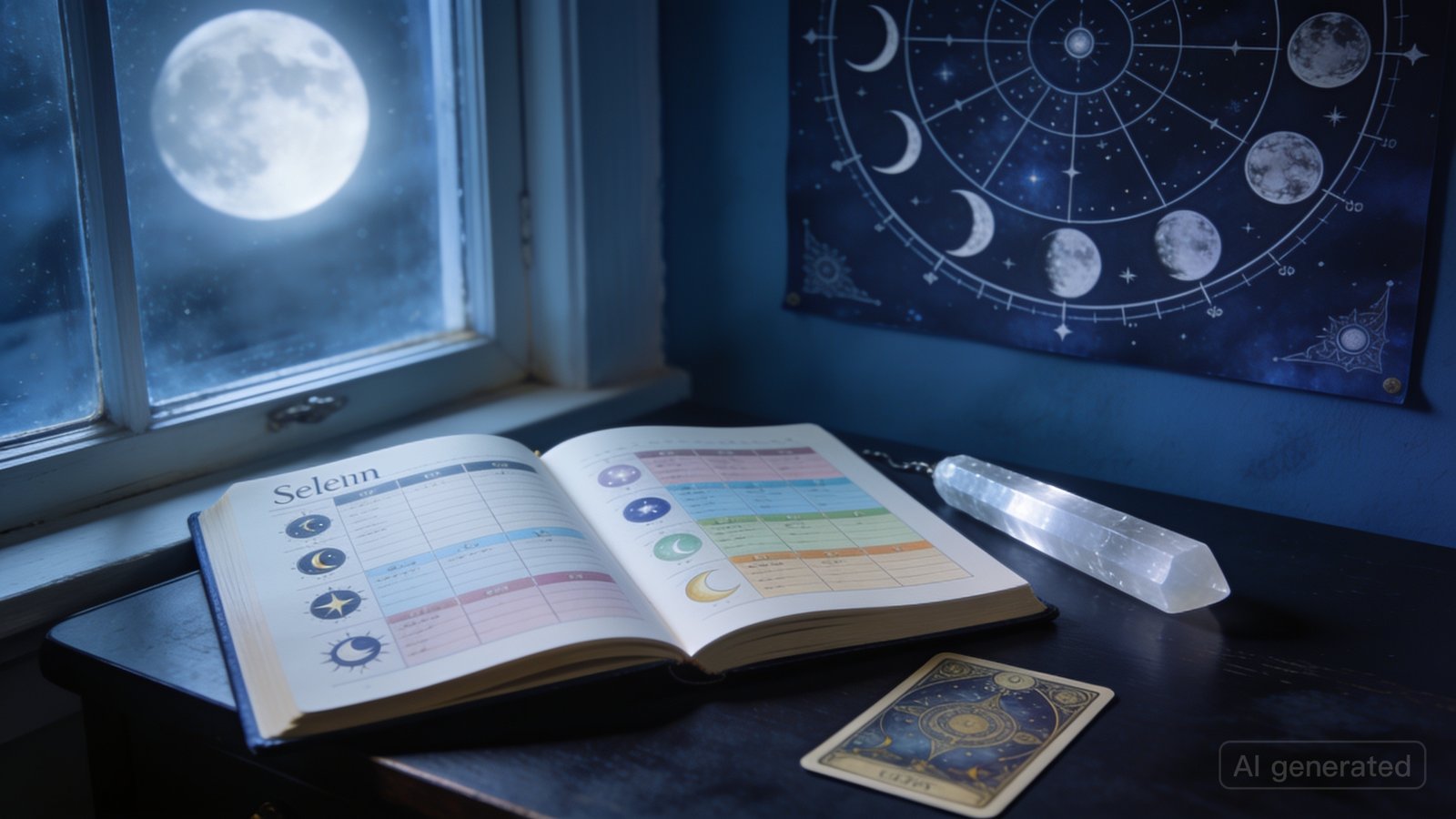
- Create entries with a symbol, time, and one-line interpretation. Example: Moon enters Leo 3:22 p.m. — expressive, warm; good for visibility work.
- Color-code: red for Mars aspects, blue for Moon phases, gray for void-of-course Moon.
- Review every Sunday evening and mark two or three anchor decisions for the week.
Keep it simple. Tracking every minor aspect turns the calendar into noise. The goal is a usable filter, not an astrological encyclopedia.
Using the Calendar for Reiki and Client Work
Once the calendar is built, apply it to real decisions.
- Schedule Reiki sessions on a waxing Moon or when the Moon is in water or earth signs for grounding, or fire and air signs for activation.
- Avoid starting new client containers during void-of-course Moon periods or Mercury retrograde shadow if possible.
- Use an applying Moon trine Venus for marketing, an applying Moon sextile Saturn for administrative discipline, and the New Moon for intention-setting workshops.
- For personal practice, use the Full Moon for release rituals and the last quarter for cord-cutting.
The calendar is a filter, not a prison. If a client needs urgent support, you do the session. The calendar helps you choose the best available window, not demand perfection.
Common Mistakes and How to Avoid Them
- Overloading the calendar: focus on the Moon, inner planets, and exact ingresses. Ignore minor asteroids and every harmonic aspect.
- Treating void-of-course Moon as all-day doom: it is a few hours. Use it for rest or review.
- Ignoring time zones: always convert to your local time. An ingress at 2 a.m. UTC is not 2 a.m. for you.
- Forgetting that applying aspects need an orb: a separating aspect is not the same as an applying one. Check the direction.
- Using sun-sign logic: Mercury in Taurus means all communication is slow for everyone is a background tone, not a personal override. Use it as context, not fate.
An astrological energy calendar works because it tracks the actual sky, not a sun-sign stereotype. Start with the four layers, build a weekly review habit, and adjust based on your practice. Over time you will notice which transits correlate with your energy and your client work.